— Marble · Bayswater, Melbourne
Marble benchtops.
Marble benchtops in Melbourne, cut and installed from our Bayswater workshop. Soft, porous, and the most beautiful thing we cut.
— 01 · From slab to install
How your marble benchtop gets made
The short version, for marble: four steps from the slab you pick to the bench in your kitchen.
- Step 1 of 4
Stand in front of the slab
No two marble slabs match, so you choose the one on our floor, not a sample. That exact slab is photographed before anything is drawn on it.
- Step 2 of 4
Decide where the veins run
Your pieces go over the photo of that slab, so you choose where the veining falls and whether an island is bookmatched. You approve the layout, then we cut.
- Step 3 of 4
See the kitchen in your marble
The 3D render shows the whole job in the slab you picked, waterfall ends and all, before a single cut.
- Step 4 of 4
Cut, profiled and polished
Marble cuts cleanly and quickly, takes any edge we offer and polishes to a high gloss. Reseal it whenever water stops beading on the surface.
See the full process, from your drawings to install →
— 02 · Edges, thickness, fluting
Marble edges, waterfall ends and fluted panels
Marble takes every profile we cut: square arris, pencil round, bullnose, bevel, ogee. Mitred waterfall ends let the veining run down the end of an island. Fluted panels are carved on our saw from the same slab as the top. Try each edge on a marble sample in 3D, then open a live quote.
Bookmatched slabs
Two consecutive slabs opened like a book, so the veining mirrors across the join.
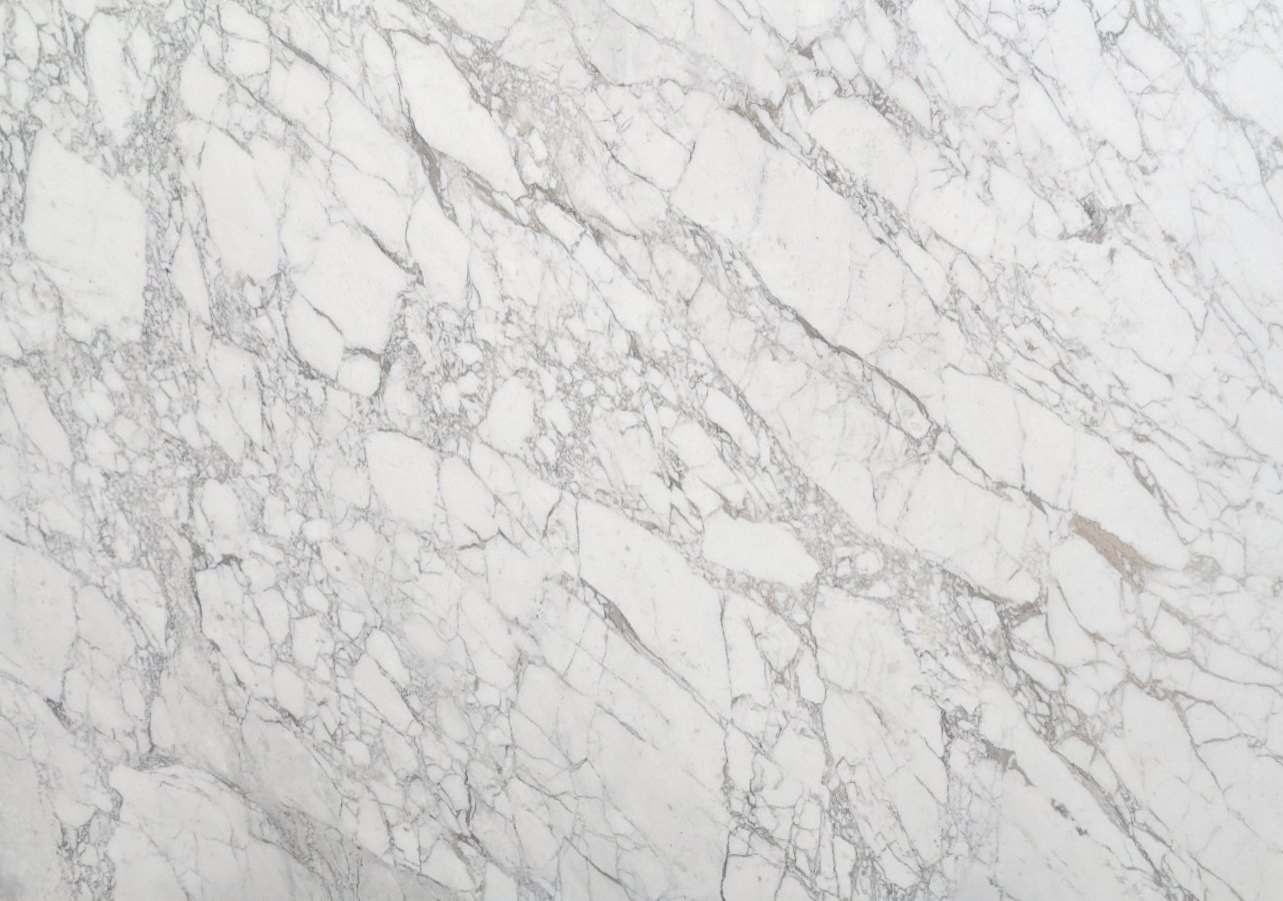
Every marble slab is different, so the one you stand in front of is the one that gets photographed, laid out and cut.
See how the slab layout works on a live quote →
Where marble works
- Kitchen benchtopsWith careAcids etch it and it ages with use; sealed, it lives well.
- Islands and waterfall endsIdealThe veining runs down the waterfall end.
- Bathroom vanitiesIdealOne of marble's classic uses.
- SplashbacksIdealFull-height panels, cut from the same slab as the top.
- Feature wallsIdealBookmatched walls show the movement best.
- FireplacesIdealA traditional marble surround.
- Outdoor kitchensNot recommendedSun and rain wear the polish and etch the surface.
- BarsIdealThin marble can be lit from behind.
- Edge profiles and flutingIdealTakes every profile we cut, and fluted panels are carved from the same slab.
Living with marble
Hardness
Marble is soft for a stone. It marks, it etches, and it ages with the house. People who want it want exactly that.
Acids and stains
Lemon, wine and vinegar leave a dull mark on a polished face. Oil left overnight on unsealed marble will stain. Sealed and wiped, it lives fine in a kitchen.
Sealing
Yes, and more than most stone. Re-do it when water stops beading on the surface.
Heat
A warm pan set down is fine. A hot pan in the same spot every night is not.
Repairs
Etch marks and chips can be honed and re-polished, usually on site. That is the trade-off for the softness.
In the workshop
Soft, so it cuts cleanly and quickly on the saw, takes any edge profile we cut and polishes to a high gloss. A chip on an edge can be repaired on site.
The names people ask for
Calacatta Viola
White ground, wine-coloured veins. The most searched marble in Australia right now.
Arabescato Corchia
Grey webbing over white. Reads as movement across a long bench.
Carrara
Soft grey on white, fine veins. The quiet one, usually the least costly.
Statuario
Brighter white, bolder single veins. Bookmatches well on an island.
— 03 · Before you buy
Marble benchtop questions: pros and cons, cost, care and silica
01Are marble benchtops banned in Australia?
No. The ban that began in July 2024 covers engineered stone, the quartz and resin slabs. Marble is natural stone and is not part of it.
02Does marble contain silica?
Marble is calcium carbonate. It has little to no crystalline silica, which is why it sits outside the engineered stone ban.
03Does a marble benchtop stain?
It can. Oil and coloured liquids left on marble that is unsealed or worn will mark it. Sealed and wiped, most day-to-day spills lift straight off.
04Is marble good for a kitchen benchtop?
Yes, for people who want a surface that ages with the house. If you want a benchtop that looks the same in ten years, porcelain or granite is the honest answer, and we will tell you so in the showroom.
05What does a marble benchtop cost?
It depends on the slab, how many slabs your layout needs, the edge and the cutouts. We quote it as a private online link that shows all of that on your slab. Not a rate per metre, because two slabs of the same marble can be a long way apart.
06Marble vs granite, quartzite and porcelain
Granite is harder and less porous, with plainer veining. Quartzite is harder than marble with marble-like veining, and still needs sealing. Porcelain needs no sealing and never etches, but its pattern is printed on the surface. Marble is the real vein all the way through, and asks for a little care in return.
07Carrara, Calacatta, Arabescato, Viola
Italian marbles named by quarry and character. Carrara is the grey-veined workhorse. Calacatta is whiter with bolder gold or grey veins. Arabescato is a dense grey web. Calacatta Viola runs purple and red. The name matters less than the actual slab, which is why you choose from the slab, not a sample.
08How do you clean a marble benchtop?
Warm water and a pH-neutral stone cleaner on a soft cloth. Keep vinegar, lemon and bleach sprays off it, because acids etch marble. Wipe spills straight away, and reseal when water stops beading.
09Marble or Caesarstone?
Man-made surfaces like Caesarstone look the same slab to slab and shrug off stains. Marble is natural rock: every slab is different, it etches with acids and it ages with the house. Choose marble for the stone itself, a man-made surface for low care.
10Is marble good for a bathroom vanity?
Yes, it is one of its classic uses. Seal it, keep perfume, toothpaste and acidic or bleach cleaners off it, and it lives well in a bathroom.
— Come and see it
Pick your marble slab in person.
Factory 4, 15 Ramage St, Bayswater. Monday to Friday, 9 to 4, weekends by appointment. Bring your plans and we will show your job on the slab you like.
— 04 · Against the others
Marble against the other stones
Marble is natural stone. Here is how it sits against porcelain, sintered and reconstituted stone: what each one is, what it shrugs off, and how it behaves on the saw.
Marble
Calcium carbonate laid down under the sea and pressed into stone. Soft, porous, and veined like nothing else. Every slab is its own.
In the workshop
Soft, so it cuts cleanly and quickly on the saw, takes any edge profile we cut and polishes to a high gloss. A chip on an edge can be repaired on site.
Where each one differs from marble: green is better, red is worse.
Porcelain Large-format porcelain slabs
A large-format ceramic slab, fired from clay and minerals, with the pattern printed on the face. Thin, light and colour-fast.
Sintered stone Smartstone · Dekton · Neolith
Natural minerals pressed and fired into a dense slab with no resin, coloured through the body. Made for heat, sun and hard use.
Reconstituted stone Quartz-look engineered surfaces, zero-silica
Crushed mineral bound in resin and cured into a uniform slab. The same colour and pattern every time. The reconstituted slabs we cut are specified by their manufacturers as containing less than 1% crystalline silica and fall outside the engineered stone prohibition. Safe Work Australia: the engineered stone ban